Every enterprise we talk to is suddenly in a huge hurry to deploy AI agents. They haven’t had much luck thus far. If you understand how agents work, it’s not hard to understand why.
To be effective, agents need to be able to do work in the same way your best employees work. But agents aren’t mind readers.
Jaya Gupta at Foundation Capital identified this missing piece — understanding the way work actually gets — as a context graph. She calls it AI’s trillion-dollar opportunity.
The graph is a collection of all of your company’s knowledge: the processes, the reasoning, and all of the invisible decisions and judgment calls people make as they work.
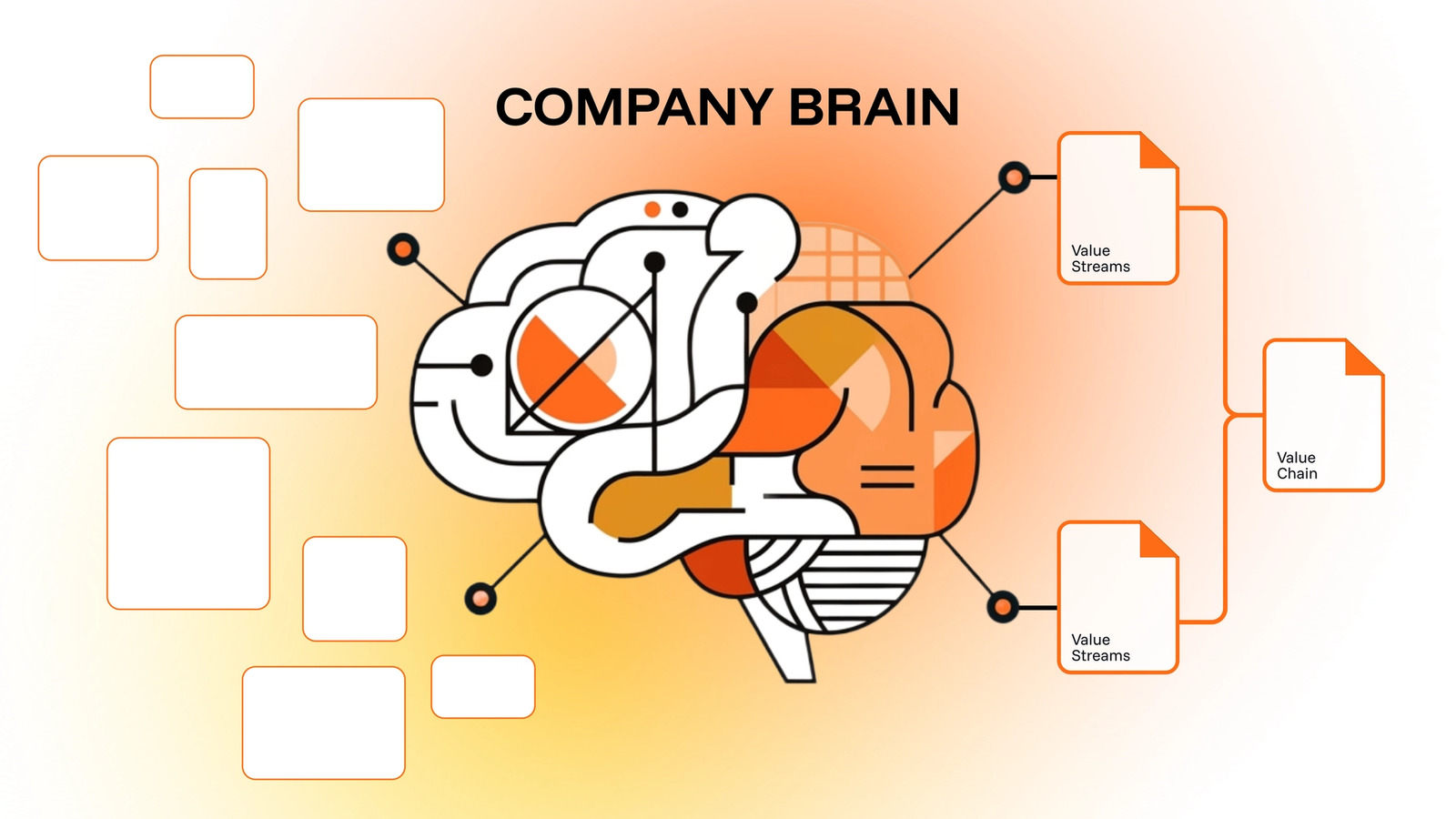
Once you’ve captured that knowledge of how work actually happens (not some idealized way of working, like an SOP) you can build a company brain.
Your company brain, like any living breathing thing, also needs to be updated to keep working.
The brain’s job is to do this hydration continuously: feeding every agent, every tool, every workflow with live context about how your organization actually operates. Custom builds, vendor automations, exceptions made for certain types of customer — they all draw from the same source of knowledge about how your company works, right now.
The tribal knowledge problem
At all companies, knowledge about how work gets done is tribal and decentralized. It lives in people’s brains.
So, while an individual may be crushing their goals because they can instruct agents based on what lives in their brain, that personal productivity isn’t adding up to enterprise gains.
We’re seeing that in the data. At companies using AI, 65% of employees say they’re personally more productive. But only 10% say it has changed how their organization works. (Gartner.)
The old way to solve tribal knowledge
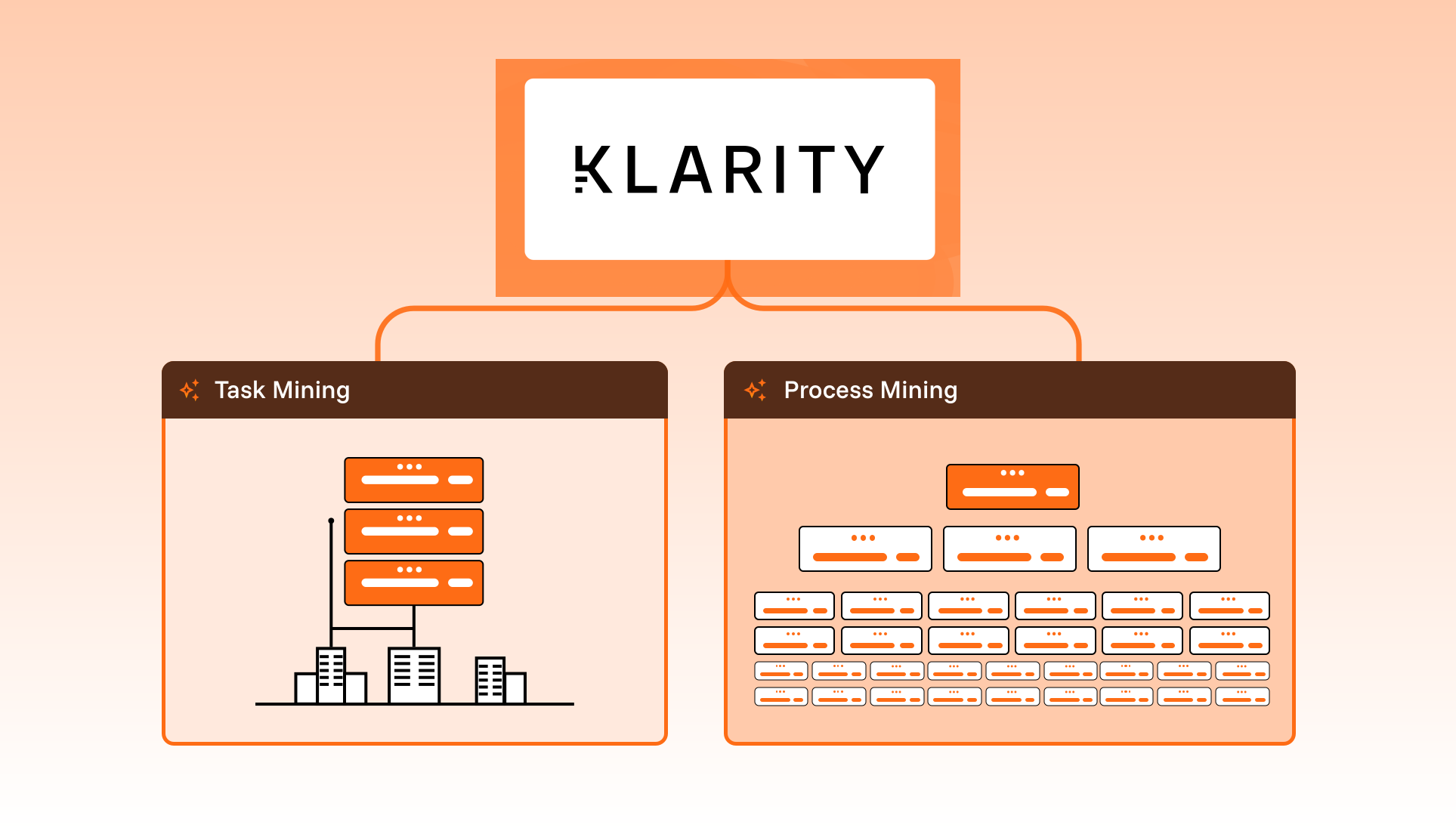
It used to be task mining was how you centralized knowledge about how work gets done. IBM-style tools would track clicks and keystrokes, then produce documentation of how work was supposed to happen. But the gap between that documentation (SOPs) and what people actually did on Tuesday morning, let in a lot of daylight. Work is dynamic, and the tasks people perform change day by day, minute by minute. Sometimes work changes in subtle ways, sometimes dramatic, but the shifts are almost always individual and invisible to the company at large.
And therein lies the rub: Using SOPs to onboard agents is like a sailor gazing up at the sky and expecting the moon to be in the same place every night. The moon moves in its own orbit and so do organizations.
People quit. New people are hired. Someone invents a shortcut that becomes the most-used process. Onboarding an agent is no different than onboarding a new hire. They don’t master their role simply by scanning SOPs; they learn by absorbing the tribal knowledge of the people around them, slowly integrating that collective intelligence into their own brain.
The agent has no clue about any of this — it assumes the moon will be in the same place and uses that compass to steer the ship.
Another outdated compass is asking consultants to map an organization. A team comes in for a few months, runs in-person interviews and analyzes the results manually. It was a fine way of doing things when businesses were smaller and more static. But capturing a moment in time and only transforming part of the business is useless for organizations that are constantly changing. AI transformation touches everyone.
The model isn’t the problem
From our point of view, the thing that kills AI deployment in enterprise is not a failure of the model or even employee resistance. The models are wildly capable and people welcome tools that offload some of their most routine work.
What kills deployment is the lack of a unified company brain that stays up to date.
Here’s how you create that brain:
First, you have to understand your work clearly enough to know which parts of it an agent can actually handle. That requires a clear picture of how work gets done.
Second, you design, build, and deploy the agents.
Third — and this is where most companies don’t finish the job — you redesign the people and the process around those agents.
That doesn’t mean firing 75 percent of your people and becoming an agent-first company, it means understanding where agents can do repeatable, routine work, freeing people up to work on higher-impact business decisions.
Fear isn’t the problem either.
While there’s been much ink spilled about the fear of being replaced by AI, we’ve found the opposite to be true. At DoorDash, people welcomed the automation of work no one ever really wanted to do. “If the team recognizes that it truly helps their life, they’re not going to say no to that. They only want more of it,” Doordash’s CAO, Gordon Lee, told us.
If people welcome the company brain that feeds the agents what they need to do the grunt work, they will also be willing to keep it alive. That means using a tool that continuously captures not just what they do, but why they do it that way.
DoorDash mapped over 3,800 accounting processes across three countries in weeks. “Now, I can quantify the impact of each step in a process — how long it actually takes, where the bottlenecks are — and rank automation opportunities by ROI.” Lee says.
Once you have an up-to-date company brain, every AI tool you deploy gets to draw from it. Your Copilot agents, your custom builds, your vendor automations: they all reach into the same knowledge base and pull the live context for the work they’re about to touch. Same reality for every tool. Same source of truth for every team.
A governance layer sits on top of that, telling you where AI is being used, what’s working, and where to invest next.
What this looks like at the desk
Picture asking the brain a question. “What work am I doing that an agent could do?”
The brain looks at what it has captured about that person’s work, designs an agent in the form of a scheduled task in Claude, and offers it back: one click to deploy.
Once you’ve deployed that agent, it too becomes part of the brain’s graph and can be deployed by others, allowing efficiencies to spread across the organization in a way that produces real transformation.
This is good for everyone, as people understand how to use AI effectively and are rewarded for it. In other words, the company brain helps people and agents work in harmony.
Why this is a C-Suite problem
If your goal is to become AI native, you’ve got to invest in building a company brain. For anyone in the C-Suite who’s getting clobbered with an AI stick, that’s a no-brainer.
You can’t deploy useful agents without knowledge of how work happens. And you can’t capture how work happens without an always-on AI system designed to capture it. That’s what we’re building at Klarity.