

Why set up a UDS? Three common reasons:
- Lock in an approved standard. Companion keeps your process documentation up to date with how work is actually done. A UDS lets you also keep a fixed, authoritative version of how the process should run — useful when you have compliance or audit requirements, or a defined set of steps you know produces the right outcome.
- Get standard-vs-reality comparisons from Advisor. Once a UDS is in place, you can ask Advisor to compare observed work against your standard. It will highlight missing steps, extra steps, and sequence deviations.
- Keep a stable target while your processes keep evolving. Your team keeps recording Companion sessions and your process index keeps improving — the UDS stays put as the reference point.
What is a User-Defined Standard?
In Klarity Architect, a process container is a living representation of observed work: Companion updates it as new sessions come in. That is intentional — but it means there is no built-in place to pin a target standard separate from observed reality. A User-Defined Standard (UDS) closes that gap. It is a document or process node whose name ends in_UDS. Rules you add to your context store tell Advisor and the Process Index to treat anything with that suffix as the approved standard, and to treat the observed process as current reality. From then on, Advisor can answer questions like “where are we deviating from the standard?” with a step-level comparison.
Setup at a glance
Estimated setup time: ~3–5 minutes. Four steps:- Set up your context store — add the UDS rules below. This is the same for everyone, whichever method you use.
- Choose your method — represent the standard as a related file or a sibling process node.
- Create and name your UDS — generate the document or process node, making sure the name ends in
_UDS. - Use the platform — ask Advisor standard-vs-reality questions as usual; it picks up the UDS automatically.
Set up your context store
Do this first, before you pick a method. The context-store setup is the same for everyone — add both rules below so Advisor reads_UDS files correctly and the Process Index governs _UDS nodes correctly. With both in place, either method works.
Rule 1 — related-file standards (Advisor)
Add this under your Advisor rules. It tells Advisor to treat any related file ending in_UDS as the approved standard:
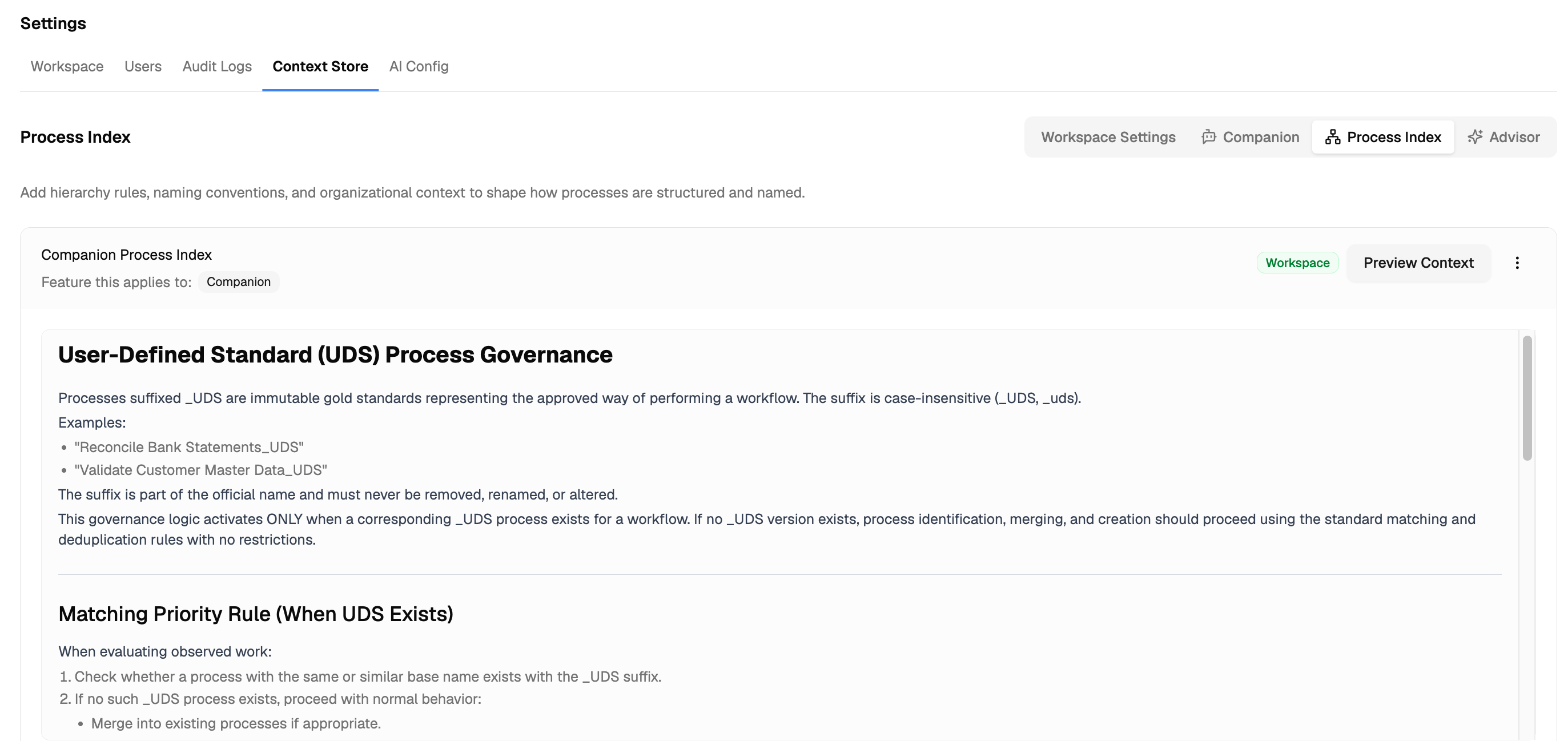
Rule 2 — process-node governance (Process Index)
Add this ruleset under each of the three Process Index Rules sections — Companion, Interview, and File Upload. The text is identical in all three places:Governance ruleset
_UDS standard. New observations are routed to the current-state sibling — created automatically if it doesn’t exist yet — and the standard only changes when you explicitly choose to refine it.
Choose your setup method
With your context store set up, pick how you want the standard represented. Both work — choose based on how you want it to show up.- As a related file — a
_UDSdocument attached to the process node. Best when you want a standard pinned to a single node without changing your process tree. - As a sibling process node — a separate
_UDSprocess next to the observed one, forming a “UDS pair.” Best when you want the standard to live in the process index itself, visible and navigable like any other process.
Method 1: UDS as a related file
Step 1 — Choose or create a template for the standard
Use whatever template represents the standard you want to lock (e.g. Klarity SOP, or a custom template you create for this). Keep it lean — include only:- Process steps
- Policy (optional)
- Key dependencies
Step 2 — Generate the standard document
Generate the document using whatever template represents the standard you want to lock (e.g. Klarity SOP or User Defined Standard). Two paths:- From a video upload: from the process node, click Generate Documents (or + Operation on the Artifact Operations page), then select that template and your video.
- From an AI interview: record the interview, then on the process node click Generate Documents and select that template.
Step 3 — Name the file with the _UDS suffix
The filename must end in _UDS. This suffix is what the context-store rule keys off. Without it, Advisor treats the file as a generic related artifact and the standard-vs-reality comparison will not fire.
Step 4 — Attach the file to the process node
Add the_UDS document as a related file on the process node you want Advisor to analyze. This wires the standard to the node.
Method 2: UDS as a sibling process node (UDS pair)
Create a process node with the same name as the target process, suffixed with_UDS, as a sibling in the process index. Populate it using the AI Interviewer — interview the person who owns the standard and let Architect generate the process content.
The two nodes form a UDS pair: the _UDS node holds the approved standard; the non-UDS sibling holds current-state execution as captured by Companion.
You do not need to create the non-UDS sibling yourself — with the governance rules from Set up your context store in place, Companion creates it automatically (same name minus the suffix) the first time it observes matching work. The _UDS suffix is case-insensitive (_UDS or _uds) and must never be removed or altered.
What to expect once it’s set up
When Advisor analyzes a node with a UDS:- It automatically recognizes the
_UDSfile or node as the target standard. - Questions about deviation compare observed process steps against the UDS as the reference.
- You get a step-level “standard vs. reality” delta: missing steps, extra steps, and sequence differences.
_UDS standard itself stays immutable: new observations are always recorded against the current-state version, and the standard only changes when you explicitly select it for refinement (for example, in an interviewer-led session intended to update it).
When to contact support
Contact support if:- Advisor is not recognizing your UDS even though the filename or node name ends in
_UDSand the context-store rule is in place. - You can’t extract or re-index the UDS document (for example, Advisor reports it can’t read the docx).
- You want to suppress specific Companion observations on a node rather than pin a standard — that is a different need, and the support team can advise on the right approach.
When you contact support, include: your workspace name, the process node name, the exact UDS filename or node name, and a screenshot of the context-store rule you added.